Topic 2.3a – Potential & Kinetic Energy

In this topic we analyze graphs to explore the relationship between potential energy, kinetic energy, mass, gravity, and height. Take your guided notes as you follow along with the video. Complete your interactive activities and do amazing on your topic quiz!

Student log in

Liveworksheets Username or email: 

Password: 


Provided by Live Worksheets
Potential-and-kinetic-energy-educational-chart-for-chemical-energy-concepts.

Vocabulary Review: Energy & Relationships

Click or tap a card (or press Enter/Space) to flip and see the definition.

FSI Courses 8th Grade Science: Potential & Kinetic Energy

🎮 FSI Courses 8th Grade Science: Potential & Kinetic Energy 🎮

Level: 1
Score: 0
Lives: 3
Best Score: 0

🟩 Potential Energy

🟦 Kinetic Energy

Potential & Kinetic Energy • Interactive Activity (Grade 8 GSE)

Potential & Kinetic Energy — Interactive

Aligned to Georgia Standards of Excellence (S8P2): Analyze and explain transformations between potential and kinetic energy within a system.
Drag‑and‑drop • Dropdowns • Auto‑grading Light, vibrant UI No external libraries
Read

Quick Primer

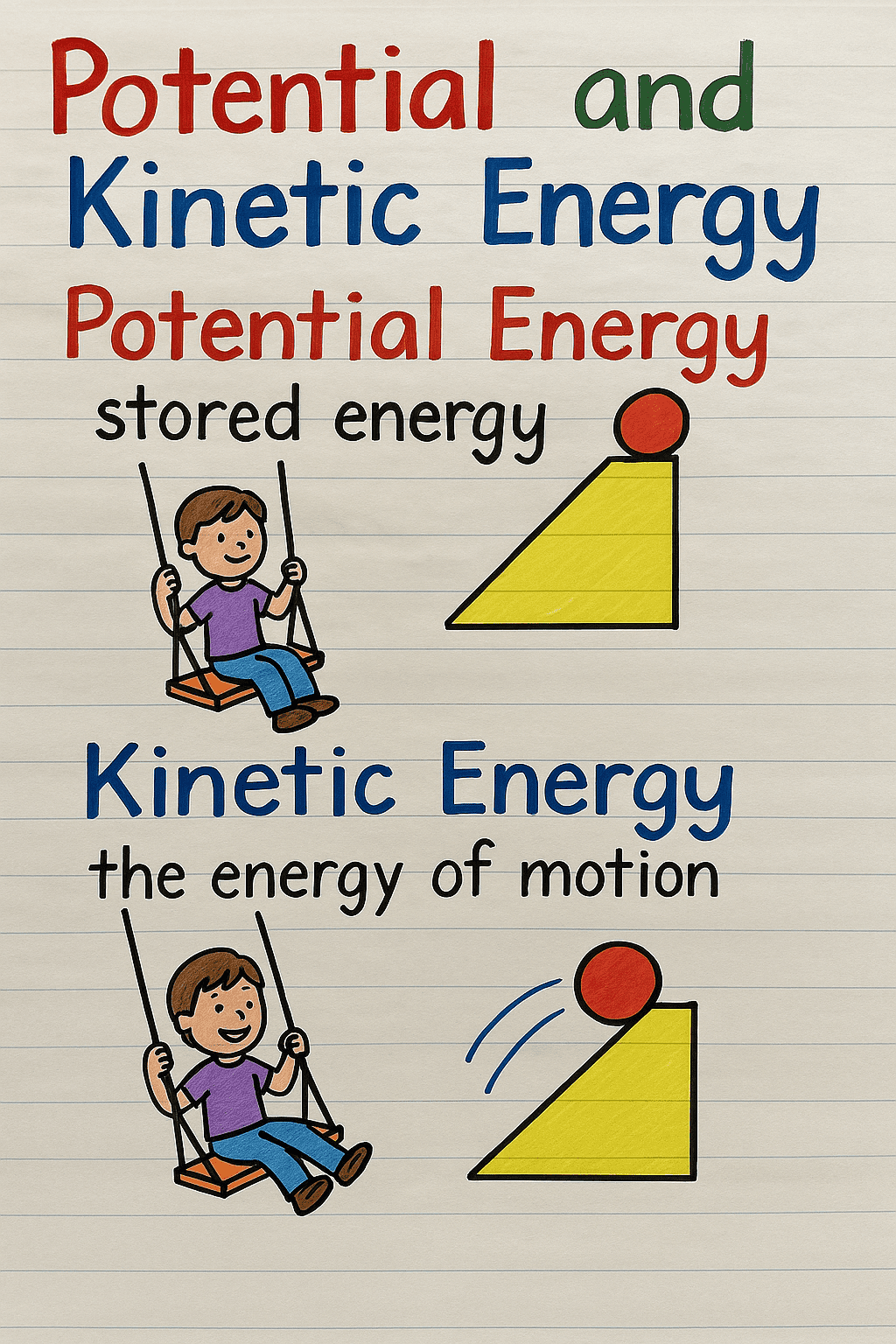
Potential Energy (PE) is stored energy due to position or condition. For height, gravitational PEm·g·h. For stretched/compressed springs, elastic PE½·k·x².

Kinetic Energy (KE) is energy of motion: ½·m·v². When an object falls, PE transforms into KE. In a closed system (ignoring losses), total mechanical energy stays nearly constant.

  • Increase height → increases PE.
  • Increase speed → increases KE a lot (depends on ).
  • Energy can transform: PE ⇄ KE.

Tip: On Milestones, watch units and which variables change.

Visualize

Graphs

v KE KE = ½ m v² (m fixed)
h PE PE = m g h (m fixed)
Interact

Drag‑and‑Drop: Sort the Scenarios

Drag each scenario tile into the correct bin: Mostly Potential, Mostly Kinetic, or Both (transforming).

Mostly Potential

Both (transforming)

Mostly Kinetic

Apply

Dropdown Checks

1) Increasing speed most directly increases .
2) The expression for gravitational potential energy near Earth’s surface is .
3) Doubling height (h) while mass and g stay the same will .
4) If KE = ½ m v², then tripling v will change KE by a factor of .
Milestones‑Style

5 Questions

1) Which device stores elastic potential energy?

2) Select all ways to increase gravitational PE of a backpack.


3) A diver steps off a 10 m platform. Neglecting air resistance, as the diver falls:

4) From the KE graph, which statements are true?

5) A 2 kg object is lifted from 1 m to 4 m. g ≈ 10 N/kg. The change in PE is about:

Challenge

Quick Compare (Optional)

For a 1 kg cart, explore how speed or height changes energy.

KE = ½ m v²
PE = m g h (g ≈ 9.8)
KE ≈ 2.00 J, PE ≈ 29.40 J
Adjust values to see which is larger.
© fsicourses.net • High‑performance static activity (single file, no dependencies)