
Topic 1.4a – Atomic Structure
In this topic we learn about the structure of an atom. We cover proton, neutron, and electron properties and their locations within an atom. We also cover setting up Bohr models for elements, atomic number, atomic mass, and valence electrons as well. Take your guided notes as you watch the video, complete the interactive activities, and do great on your topic quiz!
FSI Courses · Physical Science
Atomic Structure 101
Interactive Video Notes | Complete all four sections, then submit your total score below.
📚 Key Concepts from This Lesson
- Bohr Model (Niels Bohr & Rutherford, 1913)
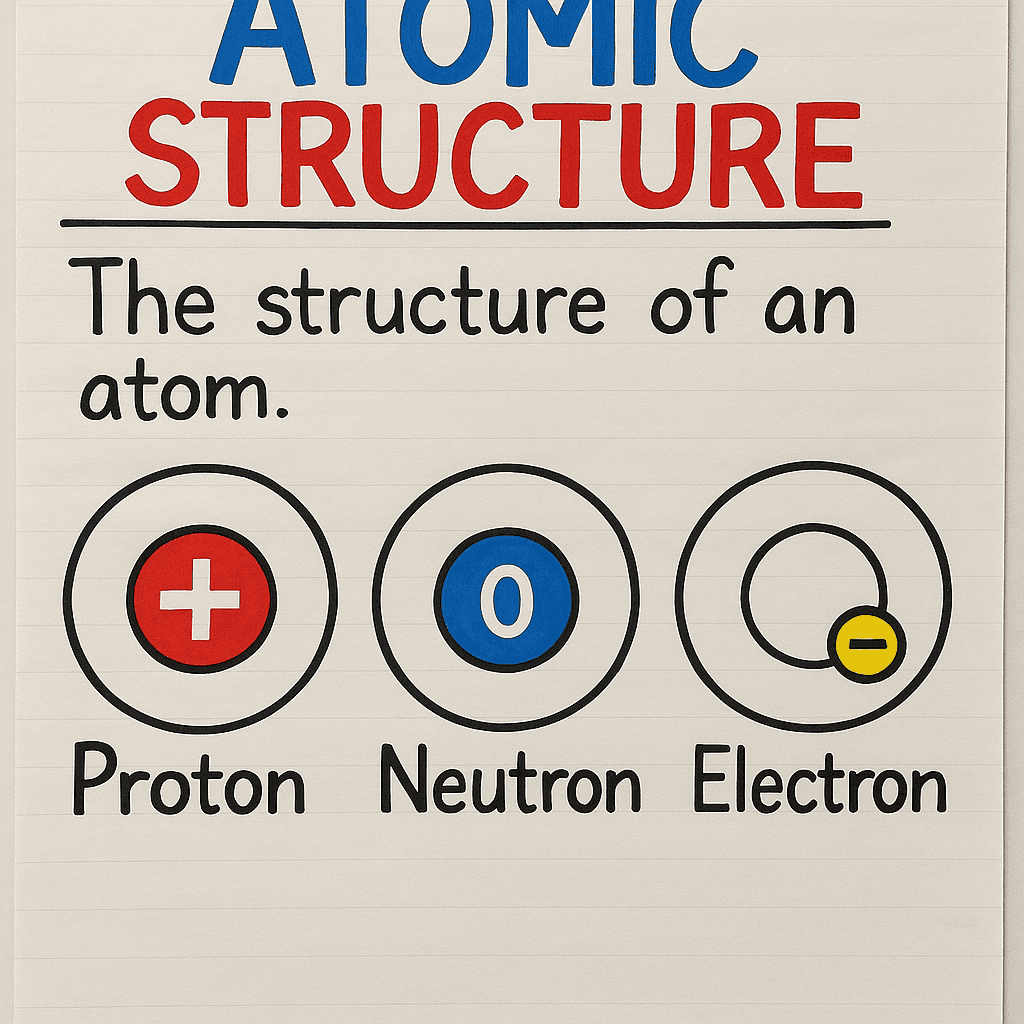
- Protons → positive charge, in nucleus
- Neutrons → no charge, in nucleus
- Electrons → negative charge, electron cloud
- Atomic Number = # of Protons
- Mass Number = Protons + Neutrons
- Valence Electrons = outermost ring electrons
- First ring max: 2 electrons
- Second & Third ring max: 8 electrons
- Full outer shell = stable element
📋
Element Reference Chart
Review the elements covered in this lesson before completing the activities.| Element | Symbol | Protons | Neutrons | Electrons | Atomic # | Mass # | Valence e⁻ | Stable? |
|---|---|---|---|---|---|---|---|---|
| Hydrogen | H | 1 | 0 | 1 | 1 | 1 | 1 | — |
| Helium | He | 2 | 2 | 2 | 2 | 4 | 2 | ✅ Yes |
| Neon | Ne | 10 | 10 | 10 | 10 | 20 | 8 | ✅ Yes |
| Sodium | Na | 11 | 12 | 11 | 11 | 23 | 1 | No |
| Calcium | Ca | 20 | 20 | 20 | 20 | 40 | 2 | No |
✏️
Section 1 — Fill in the Blank
Type the missing word(s) in each blank. (10 questions · 10 pts each)Question 1
The Bohr model was introduced by Niels Bohr and Ernest Rutherford in
.
Question 2
The Bohr model shows that the atom is a small, positively charged
surrounded by electrons that travel in circular orbits.
Question 3
Protons carry a
charge, which is why the nucleus of an atom is positively charged.
Question 4
Electrons are located outside the nucleus in the
.
Question 5
The atomic number of an element is equal to its number of
.
Question 6
The mass number is calculated by adding
plus
.
Question 7
Sodium (Na) has
protons and
neutrons, giving it a mass number of 23.
Question 8
Neon has
valence electrons, which means it has a full outer shell and is considered
.
Question 9
The first electron ring (orbital) can hold a maximum of
electrons.
Question 10
Calcium (Ca) has an atomic number of 20, a mass number of
,
and
valence electrons.
🔘
Section 2 — Multiple Choice
Choose the single best answer for each question. (10 questions · 10 pts each)Question 1
Which subatomic particle has a negative charge?
Question 2
What is the atomic number of Sodium (Na)?
Question 3
The identity of an element is determined by which subatomic particle?
Question 4
Which element has a mass number of 4 and 2 valence electrons?
Question 5
How do you calculate the mass number of an atom?
Question 6
Where are valence electrons found?
Question 7
Why is the nucleus of an atom positively charged?
Question 8
What is the mass number of Calcium (Ca)?
Question 9
Helium is considered stable because:
Question 10
Which pair of subatomic particles cancel each other out?
☑️
Section 3 — Multi-Select
Choose ALL correct answers for each question. (8 questions · 12.5 pts each)Question 1
Which subatomic particles are found inside the nucleus?
⚠ Select all that apply
Question 2
Which elements shown in this lesson are considered STABLE?
⚠ Select all that apply
Question 3
Which of the following facts are TRUE about the Bohr model?
⚠ Select all that apply
Question 4
For Sodium (Na), which of the following are CORRECT values?
⚠ Select all that apply
Question 5
Which statements about electrons are CORRECT?
⚠ Select all that apply
Question 6
Which elements shown in this lesson have ONLY 1 valence electron?
⚠ Select all that apply
Question 7
Which of the following correctly describe NEUTRONS?
⚠ Select all that apply
Question 8
For Calcium (Ca), which of the following are CORRECT?
⚠ Select all that apply
🧩
Section 4 — Drag & Drop
Drag each term from the bank and drop it into the correct blank. (10 items · 10 pts each)Part A — Match the Charge
Drag the correct charge description to each subatomic particle.
🔴 Proton
Drop here
🟢 Neutron
Drop here
🔵 Electron
Drop here
📦 Charge Bank
positive charge
no charge
negative charge
Part B — Element Data Match
Drag the correct number to complete each fact about the elements.
Neon's atomic number
Drop here
Sodium's mass number
Drop here
Helium's mass number
Drop here
Calcium's mass number
Drop here
Max electrons in 1st ring
Drop here
Max electrons in 2nd ring
Drop here
Sodium's neutron count
Drop here
📦 Number Bank
2
4
8
10
12
20
23
40
📊 Your Overall Score
—
—
Grade each section first to see your breakdown.
Pretest Grade: 0 to 79 (Beginning & Developing)
Pretest Grade: 80 to 100 (Proficient & Distinguished)
Atomic Structure Interactive
8th Grade Physical Science (Georgia Standards of Excellence)
Read: Model of the Atom
All atoms are made of three main subatomic particles. Protons (charge +1) and neutrons (charge 0) are packed in the nucleus. Electrons (charge −1) move in regions around the nucleus called the electron cloud. The atomic number equals the number of protons and identifies the element. The mass number is protons + neutrons. If the protons and electrons are not equal, the atom is an ion.
Proton+1 charge, 1 amu
Neutron0 charge, 1 amu
Electron−1 charge, ~0 amu
Atomic #= protons
Nucleus
Orbits
Correct
Incorrect
nucleus
electron cloud
proton
neutron
electron
Build & Analyze
Choose counts for a model atom. The bar graph updates. Then answer the dropdown questions.
Tip: Adjust electrons to change charge; adjust neutrons to make isotopes.
Georgia Milestones–style Questions (5)
1. Which statement correctly compares protons and electrons?
2. An atom has 12 protons, 12 neutrons, and 10 electrons. What is its overall charge?
3. The atomic number of an element is equal to the number of
4. Two atoms of the same element can have different mass numbers because they have different numbers of
5. Which change would create a negative ion from a neutral atom?