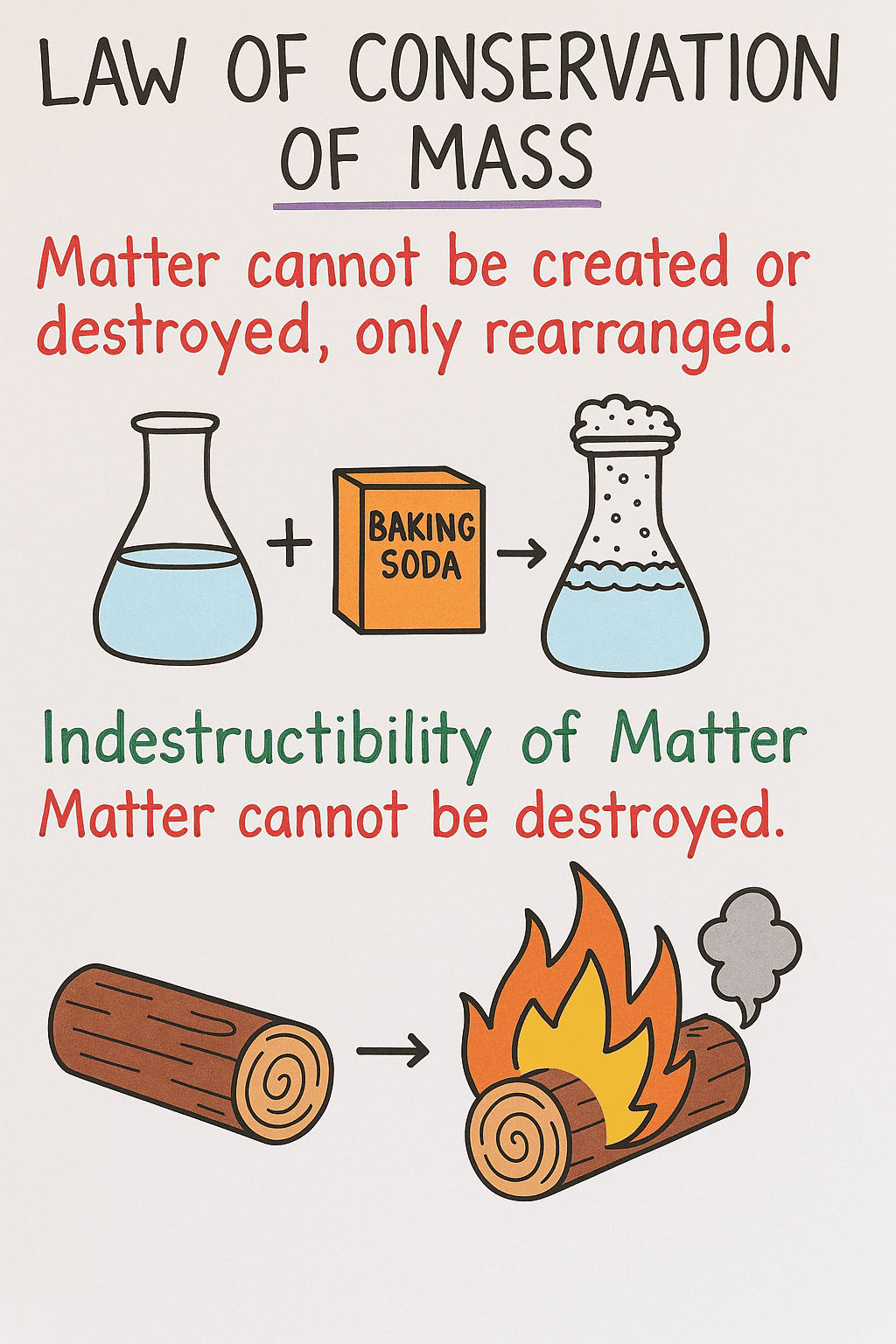
Topic 1.5 – Law of Conservation of Mass & Indestructibility of Matter
In this topic we will explain and use models to demonstrate the laws of conservation of mass and indestructibility of matter. Take your guided video notes as you watch the video, complete your practice activities and games, and do outstanding on your topic quiz!
Laws of Conservation of Mass & Indestructibility of Matter – FSI Courses
📚 FSI Courses · Physical Science
Laws of Conservation of Mass & Indestructibility of Matter
Interactive video notes — fill in the blanks, answer questions, match terms, and drag & drop to master the concepts.
🎯 Learning Objective
I can explain and use models to demonstrate the Law of Conservation of Mass and the Law of Indestructibility of Matter.
Fill in the Blank
— / 10
Multiple Choice
— / 8
Multi-Select
— / 6
Drag & Drop
— / 8
Total Score
— / 32
✏️
Section 1 — Fill in the Blank
Complete each statement using key vocabulary from the video.
0 / 10
1According to the Law of Conservation of Mass, the mass of any element at the beginning of a reaction will equal the mass of that element at the ________________ of the reaction.
Answer:
2In a chemical reaction, mass is neither ________________ nor destroyed.
Answer:
3The Law of Conservation of Mass is also known as the Law of ________________ of Matter.
Answer:
4The elements or molecules on the left-hand side of a chemical equation are called the ________________.
Answer:
5The elements or molecules on the right-hand side of a chemical equation are called the ________________.
Answer:
6The number written in front of an element or molecule in a chemical equation is called the ________________.
Answer:
7The number written behind (after) an element in a formula — such as the 2 in O2 — is called the ________________.
Answer:
8The arrow (→) in a chemical equation is called the ________________ sign, and it means "to make."
Answer:
9In a chemical equation, the coefficient multiplies every element in a molecule, similar to the ________________ property used in math.
Answer:
10In a ________________ reaction, two or more substances chemically combine to form a new substance — similar to a marriage.
Answer:
out of 10
🔘
Section 2 — Multiple Choice
Select the ONE best answer for each question.
0 / 8
1What does the Law of Conservation of Mass state?
2In the equation 2HgO → 2Hg + O2, what is the reactant?
3In the equation 2HgO(s) → 2Hg(l) + O2(g), what physical state is mercury (Hg) in?
4What is the subscript in the formula O2?
5Which type of chemical reaction is described as similar to a "divorce"?
6In a synthesis reaction, which pattern correctly represents what happens?
7In the reaction CH4 + 2O2 → CO2 + 2H2O, the coefficient "2" in front of O2 tells us:
8What score is required to demonstrate proficiency according to the FSI Courses standard?
out of 8
☑️
Section 3 — Multi-Select
Select ALL answers that apply. Each question may have more than one correct answer.
0 / 6
1Which of the following are TRUE about the Law of Conservation of Mass? (Select ALL that apply)
✦ Select all that apply
2Which of the following correctly identify the PRODUCTS in the equation 2HgO → 2Hg + O2? (Select ALL that apply)
✦ Select all that apply
3Which of the following are the FOUR basic types of chemical reactions discussed in the video? (Select ALL that apply)
✦ Select all that apply
4Which statements correctly describe what a COEFFICIENT does in a chemical equation? (Select ALL that apply)
✦ Select all that apply
5For a chemical equation to demonstrate the Law of Conservation of Mass, which must be TRUE? (Select ALL that apply)
✦ Select all that apply
6In the reaction CH4 + 2O2 → CO2 + 2H2O, which of the following are REACTANTS? (Select ALL that apply)
✦ Select all that apply
out of 6
🖱️
Section 4 — Drag & Drop
Drag each term from the word bank and drop it into the correct definition or label box.
0 / 8
✦ Drag each orange chip to its matching drop box. Click a placed chip to return it to the word bank.
⚗️ Reactants
🧪 Products
🔢 Coefficient
₂ Subscript
→ Yield Sign
💍 Synthesis
💔 Decomposition
💁 Single Displacement
1. The substances that enter a chemical reaction (left side of equation):
Drop here…
2. The substances formed in a chemical reaction (right side of equation):
Drop here…
3. The number written in front of a formula that can be changed to balance an equation:
Drop here…
4. The small number written after an element symbol that tells how many atoms are in the formula (e.g., the 2 in H2O):
Drop here…
5. The arrow (→) in a chemical equation that means "to make":
Drop here…
6. A reaction type where two or more substances combine to form one new substance — like a marriage (A + B → AB):
Drop here…
7. A reaction type where a substance breaks apart into two or more simpler substances — like a divorce (AB → A + B):
Drop here…
8. A reaction type where one element displaces another, leaving one substance by itself (A + BC → AC + B):
8th Grade Science • S8P1 (Georgia Standards of Excellence) • Sort → Balance → Test
Score:0
Lives:3
Level:1
Best:0
How to Play
Goal: Master the Law of Conservation of Matter: atoms are neither created nor destroyed in a chemical reaction — they are just rearranged. That means equations must be balanced.
Level 1 – Sort: Decide if each equation is Balanced or Unbalanced.
Level 2 – Balance: Use the −/+ buttons to set whole-number coefficients until atoms match on both sides.
Level 3 – Test: Multiple-choice and coefficient challenges modeled on Milestones-style questions.
Teacher Tips: Use this game as a warm-up or station. Have students verbalize why an equation is balanced. Encourage factor reasoning (e.g., LCM of atom counts) rather than guess-and-check.
Keyboard: Enter to submit, ←/→ to move focus, Space to activate buttons.
Level 1: Sort
Level Complete!
Great work.
Saved
Law of Conservation of Mass — Interactive Activity
Law of Conservation of Mass
Indestructibility of matter • 8th Grade Physical Science (GSE)
Quick Read: What the Law Says
Core idea In any physical or chemical change that occurs in a closed system, the total mass of matter stays the same. Atoms are rearranged, not created or destroyed.
Watch out In an open system, gases can escape or enter, making it appear that mass changes.
Diagram: Closed vs. Open System
In a closed system, the total mass (bars) is the same before and after. In an open one, gas can leave.
A) Drag & Drop: Will the measured mass be equal?
Drag a label into each scenario. Tip: You can also click a label to place it in the focused box (keyboard-friendly). Labels can be reused.
Equal Mass (closed or captured gas) Less Apparent Mass (open gas escapes)
Equal Mass
Less Apparent Mass
1) Vinegar + baking soda in a sealed flask on a balance.
CO₂ produced but trapped.
2) Same reaction in an open beaker.
Bubbles escape into air.
3) Ice melting in a sealed bag.
No water lost.
4) Steel wool heating in open air on a balance for a long time.
Some product may flake off; gases exchange.
B) Read the Graph
Mass (g) before and after a reaction in a sealed flask.
C) Milestones-Style Questions
Check Your Work
Keyboard: Tab to move focus. Press Enter on “Check Answers” to grade. Use arrow keys to open dropdowns.
Manage Cookie Consent
To provide the best experiences, we use technologies like cookies to store and/or access device information. Consenting to these technologies will allow us to process data such as browsing behavior or unique IDs on this site. Not consenting or withdrawing consent, may adversely affect certain features and functions.
Functional
Always active
The technical storage or access is strictly necessary for the legitimate purpose of enabling the use of a specific service explicitly requested by the subscriber or user, or for the sole purpose of carrying out the transmission of a communication over an electronic communications network.
Preferences
The technical storage or access is necessary for the legitimate purpose of storing preferences that are not requested by the subscriber or user.
Statistics
The technical storage or access that is used exclusively for statistical purposes.The technical storage or access that is used exclusively for anonymous statistical purposes. Without a subpoena, voluntary compliance on the part of your Internet Service Provider, or additional records from a third party, information stored or retrieved for this purpose alone cannot usually be used to identify you.
Marketing
The technical storage or access is required to create user profiles to send advertising, or to track the user on a website or across several websites for similar marketing purposes.