Topic 2.1 – Energy Transformations in a System

In this topic we cover energy transformations and the Law of Conservation of Energy. Take your guided notes as you follow along with the video, complete the activities, and do excellent on your topic quiz!

Student log in

Liveworksheets Username or email: 

Password: 


Provided by Live Worksheets
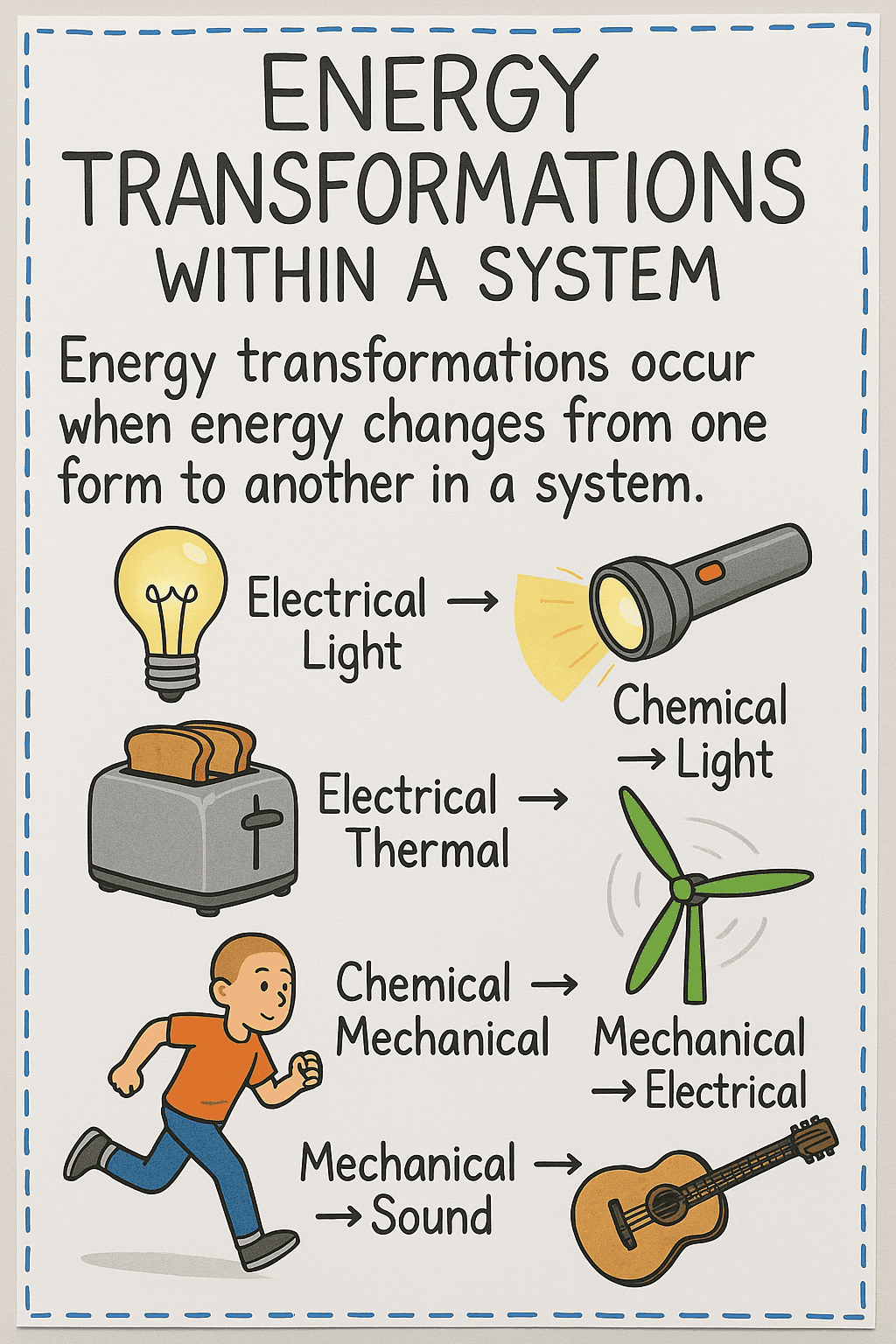
Energy transformations in various systems including electrical, chemical, mechanical, and thermal conversions, illustrated with icons of a light bulb, flashlight, wind turbine, running person, and guitar.

Energy Vocabulary Flashcards

Click (or press Enter/Space) to flip a card.

Energy Transformation
A change from one form of energy to another (e.g., chemical energy in a battery to electrical energy in a circuit).
Flip
Potential Energy
Stored energy due to an object’s position, condition, or composition (e.g., a book on a shelf, a stretched rubber band).
Flip
Kinetic Energy
Energy of motion; depends on an object’s mass and speed (faster and/or more massive → more kinetic energy).
Flip
Law of Conservation of Energy
Energy cannot be created or destroyed; it can be transformed or transferred, so total energy in a closed system remains constant.
Flip
Mechanical Energy
The sum of potential and kinetic energy in a system—energy of motion and position.
Flip
Radiant Energy
Energy carried by electromagnetic waves that radiate from a source (e.g., sunlight, light bulbs).
Flip
Heat/Thermal Energy
The energy of moving particles in matter; transfers from warmer to cooler objects as heat.
Flip
Chemical Energy
Energy stored in chemical bonds; released or absorbed during chemical reactions (e.g., food, fuels, batteries).
Flip
Electrical Energy
Energy from moving electric charges (electrons), often through a circuit, powering devices and appliances.
Flip
Electromagnetic Energy
Energy across the electromagnetic spectrum—radio, microwave, infrared, visible light, ultraviolet, X‑rays, and gamma rays.
Flip
Nuclear Energy
Energy stored in the nucleus of atoms; released when nuclei split (fission) or combine (fusion).
Flip
Sound Energy
Energy carried by vibrations traveling through a medium (air, water, or solids); a mechanical wave that requires matter.
Flip
Energy Transformations in a System — Interactive (Grade 8 GSE)

Energy Transformations in a System

Grade 8 • Georgia Standards of Excellence (S8P2) • Interactive Review
Quick Reading

What is an Energy Transformation?

Energy cannot be created or destroyed, but it can change forms within a system. Common forms include chemical, electrical, thermal (heat), kinetic (motion), potential (stored, like gravitational), and radiant (light). Systems often transform energy several times to do useful work, with some energy leaving as thermal energy to the surroundings.

Georgia example: A MARTA train uses electrical energy from the grid, transforms it to kinetic energy to move, and loses some energy as thermal energy due to friction.

Conservation of Energy System & Surroundings Useful vs. Waste Energy
Q1 (a–d) • Drag & Drop

Match each scenario to the dominant energy transformation

Drag each blue scenario card into the correct green bin.

Scenarios

Striking a match
LED lamp turns on
Skateboarder drops into a ramp
Bike brakes heat up while stopping
Keyboard: focus a card and press Enter to pick up, then Enter on a bin to drop.

Bins

Chemical → Thermal
Electrical → Radiant (Light)
Gravitational → Kinetic
Kinetic → Thermal (Friction)
Q2 • Dropdown

Hand‑crank flashlight energy chain

Choose the best chain describing the main transformations when you turn a hand‑crank flashlight and it lights up.

Q3 • Graph + Dropdown

Roller Coaster Energy Bars

The graph shows relative Potential (green) and Kinetic (blue) energy at three points. Assume total mechanical energy is conserved (ignore friction).

A B C High PE High KE
Q4 • Dropdown

Change that increases gravitational potential energy most

Q5 • Dropdown

Stopping a car

When a car slows to a stop with traditional brakes, what is the primary energy transformation in the brake system?

Milestones-style skills: identify transformations, interpret graphs, analyze variable changes, apply conservation of energy, and evaluate real-world systems.