
Topic 2.3b – All About Roller Coasters
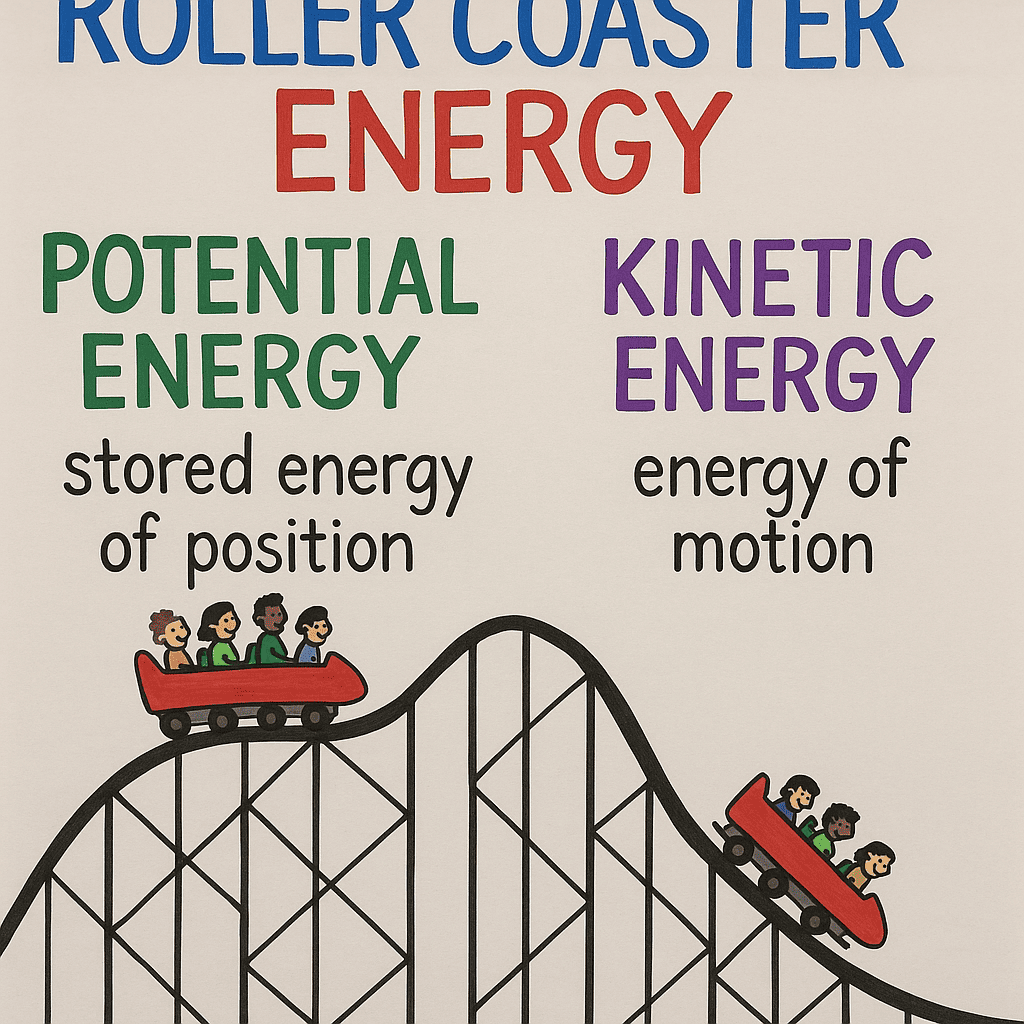
In this topic we explain the relationship between roller coasters, gravity, potential & kinetic energy. Take your guided notes as you watch the video, complete your games and interactive activities, and make sure you excel on your topic quiz!
Pretest Grade: 0 to 79 Beginning & Developing
Pretest Grade: 80 to 100 Proficient & Distinguished
- FSI 8th Science CER Writing Prompt – Roller Coasters Potential and Kinetic Energy
- Potential & Kinetic Energy Reading for Meaning (Elaborate/Evaluate)
- Understanding Kinetic and Potential Energy Transformations Activity (Evaluate)
- Marble Roller Coaster Lab (Explore/Evaluate)
- Lab Activity – Exploring Energy Transformation in a System (Explore/Evaluate)
- FSI 8th Grade Science Unit 2 Post Test
Energy & Relationships — Flashcards
Term
Tap/click or press Space/Enter to see the definition.
Definition
- Space/Enter to flip · ←/→ to move.
- 1 marks “I knew it” · 2 marks “Need review”.
- Use Shuffle to randomize. Turn on Simple backs to hide formulas & examples.
🎮 FSI Courses 8th Grade Science: Potential & Kinetic Energy with Roller Coasters 🎢
🏔️ Potential Energy
💨 Kinetic Energy
Roller Coasters: Potential vs. Kinetic Energy
Aligned to Georgia Standards of Excellence (S8P2): Describe and explain energy transformations and how potential and kinetic energy change within a system.
Read: Where does the energy go?
On a roller coaster, the lift hill adds gravitational potential energy (PE) by raising the train higher above the ground. As the train descends, PE transforms into kinetic energy (KE), the energy of motion. At the very top of a tall hill, PE is highest and KE is lowest; at the bottom of a drop, KE is highest. Along the slope, energy transforms continuously, and total mechanical energy is approximately conserved (ignoring friction and air resistance).
Tip: use keyboard – focus a label and press Enter to place it into the next empty target. Press Backspace on a target to clear it.