Skip to content

Topic c. Sorting of Animals & Vertebrates – Grouping Vertebrates (S5L1. a)

In this topic we go over the characteristics of the the five different groups of vertebrates, and how to sort them into groups. Take your guided video notes as you follow along with the video, complete the games and interactive activities, and do great on the topic quiz!

Student log in

Liveworksheets Username or email: 

Password: 


Provided by Live Worksheets
FSI Science Vocabulary Flashcards - Vertebrates & Invertebrates

FSI Science Vocabulary Review: Vertebrates & Invertebrates

Loading...

© FSI Courses | fsicourses.net
FSI Courses: Grouping Vertebrates Review Game
Score: 0 Level: 1/3 Cards Left: 0 Best: 0
Resets your saved best score for this game.

Keyboard: Use Tab to focus a card, press Enter to pick it up, then Tab to a bin and press Enter again to drop. Press Esc to cancel.

Welcome! Click How to Play to review rules.
Aligned to Georgia Standards of Excellence: S5L1 (classify organisms), focusing on differences among vertebrate groups.
Vertebrates: Grouping & Traits — Grade 5 GSE Interactive
S5L1.a — Georgia GSE

Grouping Vertebrates: Mammals, Birds, Reptiles, Amphibians, and Fish

Objective: Classify animals into the five vertebrate groups using traits like body covering, reproduction, and temperature regulation. Includes practice with drag‑and‑drop, dropdowns, graphs, and Milestones‑style questions.

Mini‑Reading: What makes a vertebrate?

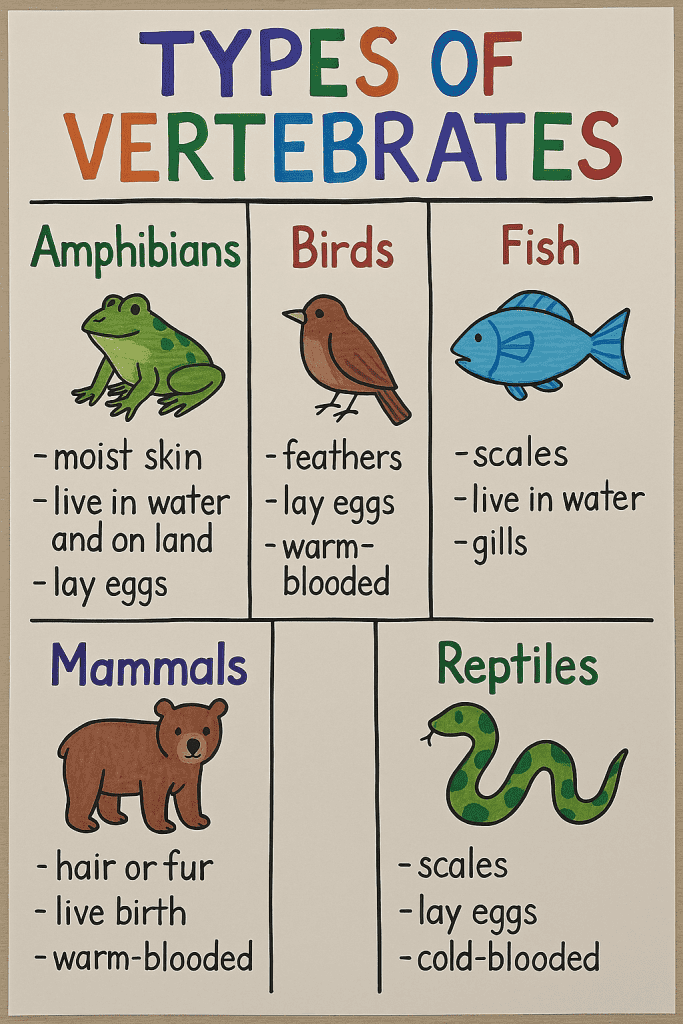
Vertebrates are animals with a backbone. Scientists group them into five major classes. Use these big clues:

  • Mammals: hair or fur; most give live birth; feed young milk; warm‑blooded.
  • Birds: feathers; beaks; lay hard‑shelled eggs; warm‑blooded.
  • Reptiles: dry scales; most lay leathery eggs on land; cold‑blooded.
  • Amphibians: smooth, moist skin; begin life in water with gills then grow lungs; cold‑blooded.
  • Fish: gills; fins; scales (most); live in water; cold‑blooded.
🦊 Hair/Fur • milk • live birth
🦅 Feathers • beak • eggs
🦎 Dry scales • eggs on land
🐸 Moist skin • metamorphosis
🐟 Gills • fins • scales

Diagram + Graph: Relative Species Counts

Bars show approximate relative counts (scaled) to compare group diversity.

Fish highest, then reptiles and birds, then amphibians, then mammals.
Relative counts: Fish ≈ 34k, Reptiles ≈ 11k, Birds ≈ 10k, Amphibians ≈ 8k, Mammals ≈ 6.5k

Drag‑and‑Drop: Sort the Animals

Drag each animal card into the correct vertebrate bin.

Animal Pool

🦇 Bat
🐬 Dolphin
🐳 Whale
🐧 Penguin
🦅 Eagle
🐍 Snake
🐢 Sea Turtle
🐸 Frog
🦎 Salamander
🦈 Shark
🐠 Clownfish
🦉 Owl

Tip: If you change your mind, drag a card back to the pool.

🐾 Mammals

🪶 Birds

🧱 Reptiles

💧 Amphibians

🌊 Fish

Milestones‑Style Questions (5)

  1. Q1. A student finds an animal with feathers, hollow bones, and a beak. Which group does it belong to?

  2. Q2. Select TWO Which two animals are most likely amphibians based on these notes?

    Animal A: moist skin, lays eggs in water
    Animal B: feathers, hard‑shelled eggs
    Animal C: smooth skin, gills as a tadpole
    Animal D: hair, feeds milk
  3. Q3. Use the bar chart to answer: Which group has the greatest number of species overall?

  4. Q4. Which statement best explains why a penguin is still a bird?

  5. Q5. A class sorts animals using body covering as the main trait. Which sort is correct?

Teacher & Student Tips

  • Common mix‑ups: Penguins are birds even though they don’t fly; whales and dolphins are mammals, not fish.
  • Milestones practice: Read graphs, focus on key traits (feathers, hair, moist skin, scales), and use evidence from diagrams.