
Topic b. Dichotomous Keys
Pretest Grade: 80 to 100 Proficient & Distinguished
- Dichotomous Keys Sentence Stem Paragraph Writing Activity (Elaborate/Evaluate)
- Exploring Dichotomous Keys Activity (Engage/Explain/Evaluate)
- Dichotomous Key Leaf Activity (Explore/Evaluate)
- Lab Activity – Exploring Dichotomous Keys (Explore/Evaluate)
- Lab Activity Dichotomous Key Template (Explore/Evaluate)
- 5th Grade Science Hands-On Lab Activity – Using Dichotomous Keys to Classify Organisms Milestones Prep (Explain/Explore/Evaluate)
FSI Courses: Dichotomous Keys Review Game
How to Play
- Level 1 – Sort with a Key: Drag organisms into bins by following a simple dichotomous key. Use hints if stuck.
- Level 2 – Build the Key: Arrange yes/no questions to classify all organisms correctly. Then sort the cards.
- Level 3 – Milestones Quiz: Read a key and select the right answer for new organisms.
Lives: You start with 3. Wrong answers cost 1 life. Score: +10 correct, +5 streak bonus, + time bonus. Your Best is saved on this device.
Dichotomous Keys — Quick Ref
- Each step has two choices (yes/no or A/B).
- Follow the path until you reach a final identification.
- Use observable traits: body covering, legs, wings, symmetry, segments, etc.
Tip: Press V to toggle voice. Use Tab and Enter to play without a mouse.
Key Steps
Bins
Organisms
Drag to Arrange Yes/No Questions
Place the most general question first. Build a path that can classify all organisms.
Your Key (Top → Bottom)
Now Sort the Organisms Using Your Key
Great Run!
Dichotomous Keys — Interactive Explorer
Aligned to Georgia Standards of Excellence (Grade 5).
Quick Read: What is a Dichotomous Key?
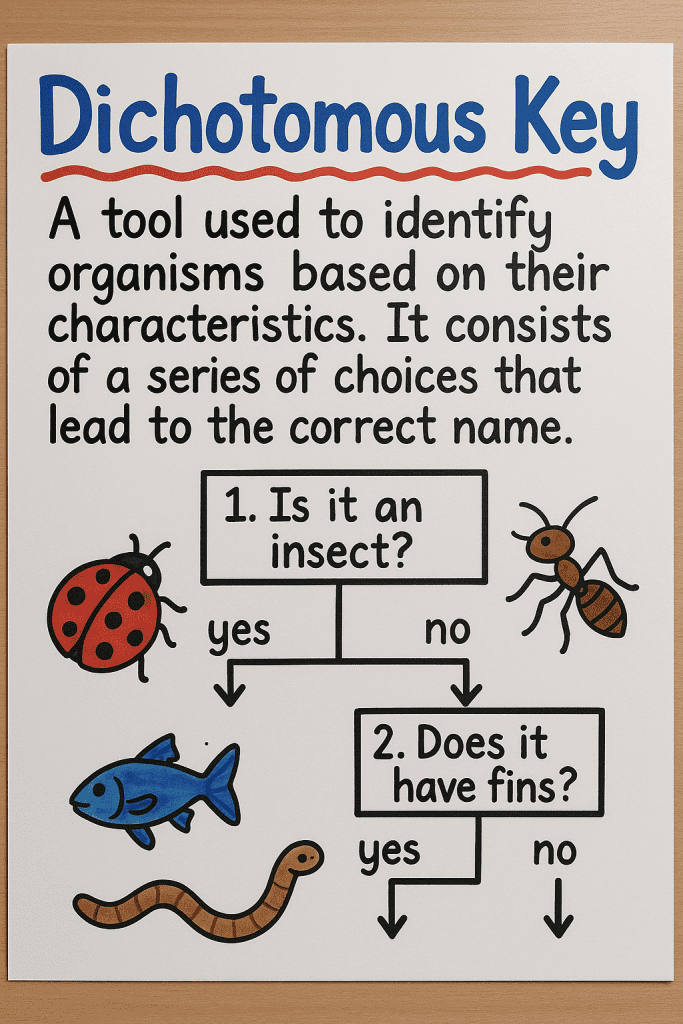
A dichotomous key is a step-by-step guide that sorts organisms by choosing between two contrasting statements at each step (a couplet). Your choices lead to the next step or to a final identification. Scientists use keys to classify unknown organisms using observable traits such as body covering, number of legs, or presence of wings.
Tip: Read each pair carefully. If neither statement fits perfectly, choose the one that fits best using evidence you can observe.
Model Diagram: Simple Vertebrate/Invertebrate Key
Trait Frequency (Sample Class Set)
Bar height shows how many organisms in this activity share a trait.
Interactives
A. Drag the Organisms to the Correct Leaf
Drag each organism card into the matching final identification box from the diagram (right side). Tip: Short tap selects; tap a dropzone to place on touch devices.
B. Follow the Key (Dropdowns)
For each organism, choose the best option for each step. Your last choice should be the identification.